Tuesday, May 13, 2014

N is for Nice and No


The napkin rings are from Ten Thousand Villages.
The dinner napkins were purchased in 1989 in Winnipeg, Manitoba.
photograph ©Kristin Lord 2014
Nominating Committee: because of several months of bad weather and issues getting some key positions filled, we have not yet given an important report to Monthly Meeting. As the person who is first named on the committee and usually the one with the most viable car, in the end it is my responsibility. Everyone has been very polite about the situation, but the job has to be done, both filling the positions and giving the report.

Upon rereading the previous sentence, maybe I should eliminate the word “polite” and insert “nice.” The etymology of the latter word (according to the Shorter Oxford English Dictionary, “nice” is from from the Latin nescius “not knowing,” which is in turn a form of nescire “to not know,” via  Old French) shows exactly the quandary we are in. If Friends will allow me, in the interests of confidentiality, to provide a composite picture of many nominating committees of more than one organization and to put my own example first, I might suggest that sometimes we are nice because we don’t know what else to do. No one wishes to upset his or her neighbor, or the Friend calling from the Nominating Committee, and people hate to disappoint by saying “No.”

Thus “Nice” and “No” are in a sense opposite. If we are nice, then we are most reluctant to say no, even to unreasonable requests for service in money and time. Many women in particular were raised to think that, if we are being “nice,” we should acquiesce to any and every work-related project and pick up articles of clothing that able-bodied people leave on the floor. The social reality that many women have been raised to be compliant makes it harder for people to believe us when we say “No” to unwanted sexual favors, despite the persistence of double standards of sexual behavior. (As my friends in women’s and gender studies would undoubtedly remind me, the linguistic and social history of “nice” and “no” when it comes to sexuality makes writing about theology look straightforward by comparison.)

As Friends, we are discouraged from waffling behind the screen of social convention, although we have euphemisms of our own when we wish to avoid giving offense. For instance, we all know that “the name of that Friend would not have occurred to me” means that the speaker believes that the Friend in question quite emphatically does not have the right credentials for whatever is under consideration.

If Quakers have heroes, inside or outside of our Religious Society, then they are often the ones who have refused to go along, regardless of the price. And those heroes do not always have to say “No” in as many words. Think of the statements of Martin Niemöller (“First they came for the Socialists...”) and Rosa Parks. All Rosa Parks needed was a physical refusal and the pointed use one word, “may” instead of  “can,” in “You may arrest me.”

In terms of work, successive Quaker committees revising editions of Faith and Practice are quite adamant about the importance of the word “No.” Section 3.09 of most recent version of Quaker Faith and Practice of Britain Yearly Meeting begins:
            It is not expected that any Friend should attend every meeting or sit upon innumerable committees. Decide what is within your physical and spiritual capacity, and be responsible in your attitude to what you do select. Be as regular, faithful, and punctual as possible in your attendance.
Rewriting Faith and Practice is hard work; the Friends who wrote that statement would have been the first to know when to call it a day. Nevertheless, to be true to the old Query, “Are love and unity maintained amongst you?” a refusal may still be “nice” in the best sense of the word.

And yet, an anecdote from my own Quaker experience provides a cautionary tale of the difficulty of one human spirit holding the potential for “nice” and “no” in proportionate measure. Friends may recall that George Fox considered telling the truth, to let yay be yay and nay, nay, among his central testimonies —indeed, the one upon which the others depend; this insistence in turn entails the use of affirmations in place of oaths. A man made of weaker material than Fox would have failed to achieve any of his goals, and yet Fox’s consistency of principle and practice had a price. Some years ago, an older and experienced Friend stood up in a group of New England Quakers who were admiring the visionary nature of the first chapters of George Fox's Journal. “I am going to ask you all a question: would you invite George Fox to your home for a formal dinner party?” Need I add that this Friend was a cook and host of legendary abilities.


Monday, May 12, 2014

M is for Military Matters (at work)


Part I: On Teaching Ancient Greek and Roman Civilization

Sed cum plerique arbitrentur res bellicas maiores esse quam urbanas, minuends est haec opinio. Multi enim belle saepe quaesiverunt propter gloriae cupiditatem, atque id in magnis animis ingeniisque plerumque contingit, eoque magnis, si sunt ad rem militarem apti et cupidi bellorum gerendorum; vere autem si volumus iudicare, multi res exsisterunt urbanae maiores clarioresque quam bellicae.
            —Marcus Tullius Cicero, de Officiis 1.22.74

But although most people think that affairs of war are greater than those of peace, this opinion must be refuted. Indeed, many have sought wars because of desire for glory, and this occurs notably among men of great spirit and talent, and all the more if they are suited for a soldier’s life and are desirous of waging war; if, however, we wish to judge truthfully, many affairs of peace have been greater and more distinguished than those of war. (English translation by Kristin Lord)

 
Library of Celsus, Ephesus, Turkey, 117-120 CE
photograph ©Kristin Lord 1997
More than once, I have heard the comment from non-Classicists that the standard university survey course in Roman civilization should be named Fascism 101. “Only after the midterm,” I reply. The midterm covers material up to and including the assassination of Julius Caesar on the Ides of March (March 15), 44 BCE; the countdown to the final exam begins with Caesar falling dead in the Theater of Pompey, which was being used for meetings of the Roman Senate because the Senate House was being rebuilt, and covers the authoritarian rule of the emperors.  Admittedly, I introduce the Roman legion, the main Roman fighting force, early on because its development mirrors that of the state as a whole. And no one can escape the reality that something rare and precious in the body politic of ancient Rome perished forever with Tiberius and Gaius Sempronius Gracchus, the great political and social reformers who came to untimely ends nearly a century before Julius Caesar has his comeuppance. Finally, let’s face it: the Roman legion, along with gladiators and animal fights, is one of the main reasons some people sign up for the course. Every time I teach it, there are students who enter the class already knowing the strategies of most of the major battles. A few of them are more familiar with the different types of catapults and siege engines than is a typical doctoral candidate in mechanical engineering.

In short, although I may emphasize the social, political, and economic aspects of the history of ancient Rome when teaching a general survey course, there is no way to avoid the hobnailed sandals of the Roman legions as they march their standards across much of Europe, the Middle East, and North Africa. There is always the moment when I show the photos of these standards, with my stomach turning as I point out what would have been the obvious comparison to my parents’ generation: the standards used by the Nazis in their iconography. Classicists may sometimes seem like a quiet bunch researching and teaching an obscure discipline, but collectively the profession has at least its share of responsibility for the propaganda behind the wars and genocides of the last century, when most of the time the type of work we do was much less obscure.

My Quaker friends sometimes ask how I can abide teaching such material. Saying that I am a language and literature specialist who does somewhat more Greek than Latin extricates me for only a few minutes. Someone will inevitably ask about the atrocities committed by both the Athenians and Spartans during the Peloponnesian War, the internecine conflict that ate up any peace dividend the ancient Greeks might have gained after fending off the Persians early in the fifth century BCE. For those of us who saw that the peace dividend after the Cold War was of short duration, there is a lesson to be learned, but that is not their point. “Surely your students are there to learn about the military tactics and the marital patterns of the Spartan warrior class, not which philosopher thought which type of matter was the fundamental building block of the universe.”

Even if a large number those who sign up for electives in Greek and Roman civilization are doing do, at least in part, because of a long-standing interest in military history and the related issues of brutal combat “sport,” that does not make it a poor reason to enroll. Short of learning about coups d’état in the ancient Mediterranean as a way of advocating armed insurrection in the present day —a position which I have never seen at work and which I hope I never will— there are no bad reasons to choose a course which crosses a such a huge number of disciplines and provides numerous opportunities in every lecture to think critically about our own society. Social and military history, literature, philosophy, gender studies, material culture and architecture, technology, agriculture, sports, economics, and environmental studies are some, but by no means all of the fields we touch upon over the semester. Despite increasing enrollments in all of our courses, we encourage critical thinking and synthesis through writing. Besides, when it comes to military history, I have known more than one member of a Quaker peace committee to sublimate frustrations at work by aiming to get the Romans to defeat the Vandals, Huns, and Visigoths via a computer simulation.

How, then, do I teach military history and combat “entertainment”? I emphasize that my goal is not to teach people to think as I do (even if I wanted to do so, that would not be appropriate), but rather to encourage a deeper understanding of conflict and its causes, as well as their expression in literature and art. I start my discussions of military hardware and gladiatorial combat with the confession that these are not my areas of expertise and interest, and that, even if they were, my class time is limited. Paper topics are set up to accommodate particular areas of discussion. Inevitably, that leads to upwards of a third of my Roman Civ. students writing essays on gladiator figurines —a sobering statistic now that the course enrollment has been increased to 180 students!— but once again, that is not the point. The reality is that the minimalist approach is unsatisfactory for all of us.

Two years ago I revamped the discussion of the Roman military to include Cicero’s substantial contribution to the development of what is called the just war theory (a subject that is already discussed in Wheelock, the textbook that is used by those students who take Latin) and, in the brief space at the end of the semester when we cover the development of Christianity, a brief reference to pacifist and non-pacifist thought in the early Church. The latter turned out to be a necessity because a few (admittedly, only a few) students who had heard of it somewhere else wrote on their exams that “the Roman empire collapsed because the soldiers were Christians, and as Christians they refused to fight.” My discussion of the just war theory has met with mixed degrees of interest in both Latin language and Roman survey classes, but those who have looked at it in depth have run the gamut of professional interests and, to the limited degree that I can tell, underlying beliefs about war and peace. Indeed, some of the most perceptive responses to short essay questions on Cicero have been from students with no philosophical or religious objections to the use of military force per se, but who are looking for ways to reduce the incidence of it.

More people have responded to my decision to include two fifty-minute PowerPoints on the Roman economy and environmental issues in the Roman world. Many students have found it distressing that the Pax Romana, the generally peaceful period in the “high” Roman Empire in the first two centuries of the Current Era, reached its limits not only against more nimble invaders, but also sputtered when confronted with problems in the food supply, disease, and instability in climate. All of  these became major factors in the third century CE. The success of the Roman legions, which were stretched rather thin through most of the empire,  depended on the acculturation of millions of people, a decent standard of living, and, most of all, food. This is panem et circenses (bread and circuses), if one likes, but almost all of my students are concerned about the prospect of environmental instability in our own day leading to social instability, or worse, disruptions in the food supply.

On the Greek side, one of the most popular paper topics for my class this winter was failures and successes in peace treaties and negotiations during the fifth and early fourth centuries BCE. Once again, Quakers would not find most of these papers written from a pacifist perspective, but would nevertheless see a number of thoughtful discussions of Greek arbitration. For the final exam, the most popular question allowed students to compare issues drawn from two lists which I provided in advance. The first list covered any major event from the First Peloponnesian War (460 BCE) through the trial and death of Socrates (399 BCE); the second list included about a dozen major events in the last century, such as issues leading to the outbreak of World War I, the Treaty of Versailles, the Cold War, and Canada-US relations since 1945. The latter list emphasized topics the students would have seen in high school history (I had access to the Ontario curriculum when designing the question), although they were encouraged to look at secondary literature while approaching all aspects of the question.

Part II: What can Quakers say about the tendency to encourage military service as a means of funding higher education?

Encouraging post-secondary to think more broadly about issues of war and peace, regardless of the conclusions they may draw, may come to naught if an increasing number of them cannot afford to attend college or university. This brings me to the second military matter that I see in my work as an academic and one which happens to be especially relevant this week, given that International Conscientious Objectors Day is upon us on May 15 (see here to a link from the Peace Pledge Union describing the day). Very often in the United States, and to some extent in Canada and other English-speaking countries, students who are having trouble paying for their educations are encouraged to sign up for the military. This raises a number of troubling concerns. Here I am not talking about students who whose wish to pursue a military career arises from their own convictions (although I would support those who have doubts about such service, as well as the appreciable number of people who have changed their views about the armed forces once confronted with what military service entails), but rather those who see few alternatives.

Friends and others have done a superb job of trying to find legal ways out of the military, primarily in the US, for those who have enlisted in the armed forces, but who have come to object to military service on moral grounds. While some of these men and women signed up out of conviction, a large number did so for economic reasons, including support for post-secondary study. One of the best examples of this work is that of Quaker House in Fayetteville, North Carolina. Other Friends have tried to help those who have heard of soldiers coming to Canada during the Vietnam and tried to follow their example. This has NOT been successful, despite the use of all available legal avenues. The policy of the Canadian government has long since changed. The young people involved in recent years have been deported back to the US and court-martialed. (Note to anyone reading this post who is either thinking of following suit or encouraging someone else to do so: I urge you to Contact Quaker House in Fayetteville and/or the GI rights hotlines in the States.) Finally, the American Friends Service Committee (AFSC), a number of Quaker Meetings, and non-sectarian peace organizations such as the Center on Conscience and War have worked at counteracting the all-pervasive nature of military recruitment by helping young people find ways of achieving their goals without enlisting. Thanks to the efforts of the Canadian Friends Service Committee (CFSC), a Canadian brochure which covers this topic can be found here. More work on counter-recruitment can and should be done, in all English-speaking countries.

Other than publicity (which is a serious problem in and of itself, especially to those who have been raised in a military culture), perhaps the biggest impediment to encouraging alternatives to military enlistment for people who want to attend college or university is indebtedness. Most young people from English-speaking countries who need help funding their post-secondary education will turn to loans. Students from lower-income families are the most likely to be steered to loans and the least likely to complete their degrees, making them reluctant to become indebted.

What can we as Quakers say about that? 
Another photograph of Kristin Lord by Peter Stettenheim.
This was taken two years after the first one.

Sunday, May 11, 2014

L is for Leningrad, Part I


Leningrad, USSR; known also as St. Petersburg, Russia (Russian Санкт-Петербург/Sankt-Peterburg) from 1703 to 1914 and again from 1991 to the present; renamed Petrograd from 1914-1924; known less formally as Peterburg and Piter (publicly when the city has been named St. Petersburg; privately and courageously when it was called Leningrad)

Panoramic view of St. Petersburg from the Palace Bridge in 2009;
taken by "Panther" and uploaded from Wikimedia Commons under a Creative Commons license.
Until about ten years ago, students at the Department of Russian for Foreigners at the university stayed in a dormitory in an area partially visible behind the columns at the far left.
Lermontov (known to Russians primarily by his first name and patronymic, Mikhail Yuryevich) was the most popular poet of Russia's literary “golden age” in the nineteenth century after Aleksandr Sergeyevich Pushkin. One of Lermontov’s most distinguished poems, “Death of the Poet,” contains a bitter lament at the death of Pushkin in a duel. Pushkin, for whom a duel formed the climax of his own “novel in verse,” Evgeniy Onegin, did not take the implied warning to heart, or at least he was unable to overcome the cultural and all-too-human temptations. Neither did Lermontov: four years later he also was to die in a duel.

Although I read about the cause of Pushkin’s demise when I first studied Russian in high school, I learned the details when I was studying in the summer program at the Department of Russian for Foreigners at Leningrad State University during the late 1970’s. Students in the program took a field trip in a bus that retraced Pushkin's last days. Many of the historic buildings were still standing or had been rebuilt after World War II. The bus driver and the Russian literature lecturer, a professor from the regular philological faculty invited along for the occasion, both showed such intimacy with the subject matter that the duel might have taken place the previous year, not 140 years before. One of them —I no longer remember who—  at one point quoted the famous Pushkin opener, “Не дай мне Бог сойти с ума,” “God grant that I don't go out my mind.” The context was not the same as the original, in which Pushkin has a reverie of slaking his madness in the wilds of nature, only to be brought back to his senses by remembering that the insane were locked up. But we all were inclined to think Pushkin must have gone right over the top when he agreed to yet another duel (he apparently was connected to as many as twenty-nine), regardless of what the biographers had to say about his motivations.

God grant that I don't go out of my mind. About ten days after we arrived in Leningrad, I stepped out onto the sidewalk from the foreign students' residence, looked up into the brilliant early summer afternoon, and realized that my parents' tax dollars, and mine, too, whenever I had a summer job, had helped to purchase missiles that were programmed to head right at me (although of course that was not the intent). I had joined Friends about a year before, in part because of my support for the peace testimony, but never before had I been cut to the core, as Margaret Fell would have said.

We were in the period of détente under Presidents Carter and Brezhnev, but anyone could have been forgiven for not knowing it. The acronym used by US defense planners during that period was MAD, for Mutual Assured Destruction, i.e., the possession of an arsenal big enough for the USA and USSR to be able to guarantee to annihilate each other, and then large enough still for whatever was left of the US to come back and finish the job. If it sounds like lunacy, it was (and still is, as both sides have massive nuclear stockpiles to this day); but no military planner  or mainstream politician was going to step away from it on his own, any more than Pushkin could walk away from challenging Georges D'Anthès, who was reputed to have tried to seduce Pushkin's wife, Natalya Goncharova.

But step away we all did. The Cold War ended with the demolition of the Berlin Wall in 1989, the unification of East and West Germany, and the demise of the Soviet Empire. Millions of people  benefited from the physical and moral courage of Soviet President Mikhail Sergeyevich Gorbachev and Pope John Paul II, from the recognition of President Ronald Reagan and his advisors that the West had in President Gorbachev a partner for peace —and from the determination of countless others, many of whom will never be publicly known.

However, if we thought that the post-Cold War status quo would remain indefinitely, we were naïve. As I write about Leningrad, on Mother’s Day in 2014, Russia has annexed Crimea, and separatists in eastern Ukraine are holding a referendum on autonomy. While no one expects another Cold War, no one knows what will happen next. God grant that we don’t go out of our minds.
 
Kristin Lord, a few months before studying in Leningrad.
photograph by Peter Stettenheim


Tuesday, March 25, 2014

K is for Kitchener (Horatio Herbert, First Earl Kitchener)

Knitting has long been a pastime for people looking for ways to support loved ones on the battlefield —not to mention Friends trying to complete a project and eyeing a few spare moments during Meeting for Worship for Business. It was perhaps inevitable that an efficiency-minded general might suggest an improvement in knitting. Thus Horatio Herbert Kitchener, one of the British military leaders during World War I, suggested grafting instead of sewing together the ends of pieces at the toes of socks because the soldiers under his command found their toes chafing from uncomfortable seams. The resulting procedure, called the Kitchener Stitch, is now used in a variety of knitting, including Fair Isle-style sweaters knitted in the round. My mother also finished the thumbs of her mittens using the Kitchener Stitch and wondered why more people did not try it.

If Kitchener had "stuck to his knitting" and not been a general, I might have fewer problems with the legacy of the man than I do. (In saying this, I wish to emphasize that I am no expert on modern history.) On the other hand, he might not have been known to history —whether through knitting or anything else— had he chosen a different career.

Lord Kitchener was associated with many of the military events during the Second Boer War and the first half of World War I, but there are two which immediately come to mind. Both would almost certainly result in war crimes charges if they were to occur now. The first entailed corralling some 128,000 Boer civilians and around 100,000 Black non-combatants into concentration camps during the Second Boer War (1899-1902). The death toll among the Boers was around 28,000, and that among the Black internees perhaps around 20,000, although there are no exact figures for the latter group; however, a common modern assessment —and the most charitable— is that casualties for both cohorts were the result of incompetence and callousness and not malice of forethought. (For a range of views as to Kitchener's intent, see the summary of scholarship in the Wikipedia article on the Second Boer War.) In effect, Kitchener and his subordinates had a lot to do with the "invention"  of the twentieth-century concentration camp, although he had ample precedents, most notably similar camps set up by a Spanish general in Cuba in 1896 and an American general in the Philippines earlier in 1899 (see the BBC article linked here for more information). We may also compare the North American and Australian treatment of their Aboriginal peoples by herding them onto reservations, where many perished. (Nevertheless, as horrific as the Boer War camps were, they were not deliberately set up as "death camps" in the Nazi sense.)

The second event, Kitchener's decision to sentence sixteen "Absolutist" conscientious objectors to death so as to discourage others, was interrupted only by his own demise in July of 1916 as the result of a German mine during a sea voyage to meet with the Russian command.
Recruitment poster from 1914 showing Lord Kitchener. Photo deemed in public domain by Wikimedia Commons

Conscientious objection as we know it today was in its relative infancy during World War I. At least in Britain, military officers served on tribunals that assessed applications for conscientious objection, and the grounds for acceptance were vastly more limited than they were in the UK and North America during World War II.  Conditions were harsh for those whose claims were approved; these were limited to a subset of those whose consciences permitted non-combatant military service (as with the Friends Ambulance Unit) or alternative civilian service (e.g., in hospital or agricultural work). The "Richmond Sixteen" were a group of "absolute objectors" who felt that any work that freed someone else to contribute to the war effort, even indirectly, was against their conscience.  While all "Absolutists," who included a number of Quakers, were imprisoned during World War I, only the sixteen, who also included Quakers, received the death penalty. They were previously incarcerated in Richmond Castle but had already been shipped to France, where they were tortured and forced to watch the executions of deserters, when Kitchener himself died. Despite the consequences, all but one man, who eventually did agree to serve as a non-combatant, kept to their principles as Absolutists. By sheer good luck, a member of the group had managed to drop a postcard out of the train in London, and a second man had sent a coded message from France. Word reached Arthur Rowntree, a Quaker Member of Parliament from York. Rowntree in turn interceded with Prime Minister Asquith to have the men's sentences commuted to ten years' hard labour. By that time, the Absolutists had some public support.

I first heard of the plight of the "Absolutists" when I was living in Cambridge, England, and Myrtle and Philip Radley, then retirees living in the city, invited some of the Young Friends to lunch. Philip Radley was an Absolutist objector who was sentenced to prison one month after Kitchener was killed, which perhaps spared him the same fate as the Richmond Sixteen. Philip nevertheless spent three years imprisoned under dire conditions. He was small of build and stature, and it was amazing for this reason alone that he did not suffer even worse consequences. He later became the principal of his old high school, the Quaker school Ackworth in Yorkshire, during World War II. (For a longer version of the account we heard, follow the link here to an extended interview in the 1970's with a scholar from the Imperial War Museum.)

Not surprisingly, the name "Kitchener" turned my stomach when I ended up moving some years later to the Ontario city named for him, although it was only when doing the research for this post that I connected Field Marshall Kitchener with the man who had personally ordered the execution of some of Philip Radley's fellow Absolutists. The City of Kitchener was originally called Berlin by the predominantly German population who settled there, but by the summer of 1916 the name was more than a liability. After the Field Marshal's death, "Kitchener" was chosen, out of a burst of patriotic fervor,  in a referendum for a new name for the city. Those opposed to a name change were in the minority and were in any case too intimidated to speak out.

The historical understanding of Lord Kitchener's career has changed dramatically over the course of nearly a century, and there have been intermittent calls within the city to change the name, either back to Berlin or to something else. The city is part of a region (i.e., county) with the same name as its neighbour city, Waterloo. (By "neighbour" I mean that they are so close that the house we owned in Kitchener was literally on the boundary between the two cities, in the middle of a row of similar houses on virtually identical lots; however, the number of the house next door in Waterloo was so different from ours that we soon gave up ordering pizza.) Kitchener is still the largest community in the area, so the twin cities are colloquially referred to as Kitchener-Waterloo (or simply K-W, which sounds like something on a bill from the power company) and not "Waterloo Region." There does not seem to be much appetite for a name change, in large part because the moniker now has a meaning that has grown beyond that of the man from which it originated. When people hear the word "Kitchener," they are much more likely to think of an excellent symphony orchestra, museums, a minor league ice hockey franchise, and faculties connected with several university campuses and a community college —not to mention the Canadian headquarters of the Mennonite Central Committee and its unstinting work for peace.

The Friends Meeting in the area is Kitchener Area Monthly Meeting, and for more than three decades it has owned a Meeting House in downtown Kitchener. The Meeting was named during the 1960's. While the people who chose the name of the Meeting have either passed away or long since left the area, anyone connected with the Meeting can make reassurances that the name was chosen for practical reasons that had nothing to do with Horatio Herbert Kitchener. The name "Kitchener" was the most obvious identifier for the location, and the word "Area" means that it includes the rest of Waterloo Region and the surrounding vicinity —and further attenuates any association with the man. At this point it would be complicated to change the name of the Meeting even if Friends wanted to, because of the legal paperwork involved with a registered charity.

If the subject of renaming either the city or the Meeting were to come up, I would probably not have a say in the matter. We no longer live in Kitchener, and in any case I am an American and thus do not vote in Canada. I am also a member of an American Meeting (in part because I am a founding member of that Monthly Meeting and vote by absentee ballot in a nearby town). Despite my connections with KAMM, as it is informally called, this is one occasion when I probably do not have a dog in the race (to use a rather un-Quakerly metaphor). That said, if there were a credible proposal for a more benign name for the City of Kitchener, I would be delighted at the possibility of "Kitchener" disappearing from the Meeting letterhead as well. The names "Waterloo" and "Berlin" would not cross my mind because of their own military associations, but people have already used the term "Grand River" to refer to the area hospitals and public transit, which provides at least one readily available alternative. Certainly a name change might do justice to all of humanity, not only to the memories of the Richmond Sixteen and the tens of thousands who perished as a result of Lord Kitchener's callousness in South Africa and elsewhere.
Friends Meeting House, Kitchener, Ontario. Photo by Kristin Lord ca. 1998  

Friday, February 21, 2014

J is for Jesus Lane


Just as all of us parents were confident about our children’s progress through the first grade, the teachers requested that we buy display panels for an exhibit called “The Story of Me.”  Our first-grader is now a teenager, but the project was so detailed that I remember most of its complications. “The Story of Me” was intended as a joint parent-child project that included pictures of a variety of family members at different stages of life, as well as pets, family weddings, homes and apartments, holidays, and trips away. If possible, all photos were to be fully identified and dated, but otherwise everything relevant was acceptable. This last provision gave ample opportunity for omissions, strategic and otherwise, which could be papered over with yet more photographs. I began to feel I knew what President Nixon might have been thinking during the Watergate cover-up, and not because of his Quaker connections.

As it happened, the issue of religion came up early. There are only around 1200 Friends in Canada, and as far as I know, we are the only Quaker family connected with that school, at least for any length of time. Our first-grader wanted wedding photos, and the ones she chose required a bit of explanation for those unfamiliar with Quaker marriage customs. Well, I shrugged, “Some parents will bring in pictures of themselves snuggling with their newborns in the neonatal ward, so I guess sex is already by implication part of the story. If we bring up religion and, by extension, politics, then among the lot of us we will have hit the trifecta of impermissible discussion topics.”

If only the project had ended there.... The one relevant photo that seemed to have gone missing was the sole extant family picture of the place where my husband and I had met: Jesus Lane Friends Meeting House in Cambridge, England. (At least some of my photos from that period turned up years later in my parents’ basement next to a box of craft supplies, the day before the house was sold, so we may have it once again, although I haven’t checked.) Of course, that was the one our daughter most wanted, and it had to be the same size as the other pictures. No matter how I tried, I couldn’t get the Meeting website to download and print. (Computers weren’t then what they are now.) We all looked at each other: would a map of Cambridge do? No. How about some other building in the city —let’s say the most impressive one we could find — King’s College Chapel, maybe? That would hardly reflect the Quaker testimony of integrity, now, would it?!

I eventually got the Meeting website to print. By some miracle the photo was the right size. (I vaguely remember e-mailing the warden as to whether it was acceptable to use it.) The pictures and captions were glued on in the right spots. Our project, like the others, received a warm reception.

At that point I just wished that the members of the older generation of Jesus Lane Meeting whom we had known when we were Young Friends were still alive, as I would have liked to have returned to them with our daughter in tow. I am indebted to a number of them in different ways. Some of these Friends will come up in other posts; other reminiscences are more personal in nature. The Friend whose name came to mind that day, though, was the redoubtable Anna Bidder. Friend Anna was known to the academic community as a biologist, an expert on cephalopods. She was a co-founder and the first president of Lucy Cavendish College at the University of Cambridge. She was also familiar in Quaker and in some non-Quaker circles as one of the co-authors of the pamphlet Towards a Quaker View of Sex, to which she contributed her biological expertise. But to Young Friends in Jesus Lane Meeting she was most familiar in two capacities: as a long-serving Elder and as the indefatigable hostess of Young Friends’ gatherings on Sunday evenings in her home on the south side of Cambridge.

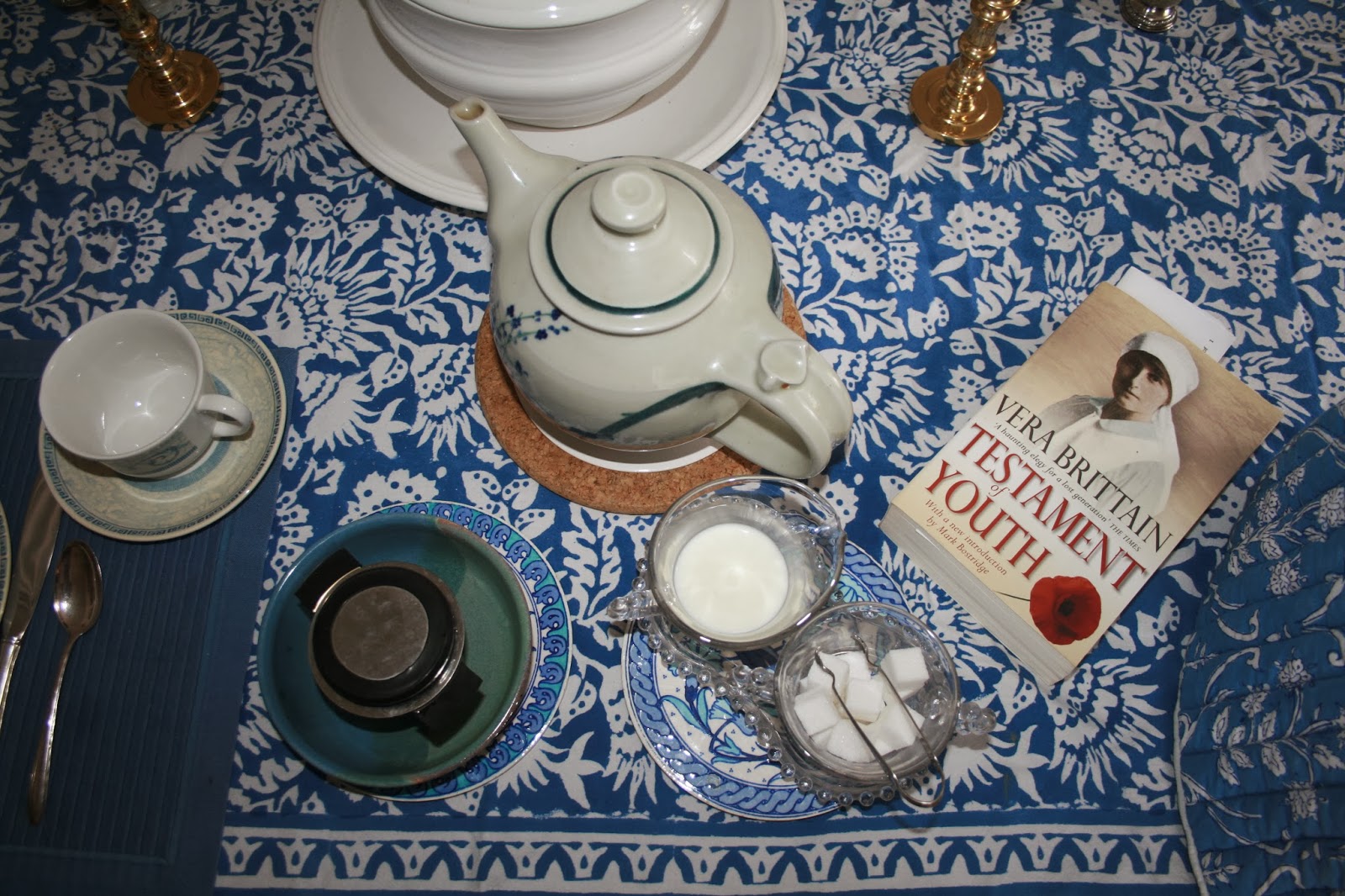
We would turn up punctually at seven p.m. and find her living room blue with cigarette smoke. (She lived to be ninety-eight, and I have no idea if she ever did quit smoking.) At around eleven, she would wave us off with the words, “I love you all very much, but I have a meeting tomorrow at eight a.m.” Sometimes one or another of us would visit alone. On one such occasion she made me tea, and then found out to her horror that my all-American method was rather primitive — tea bags. If someone disliked having the tea leaves steep in the pot indefinitely, one could always make a smaller pot and use a tea strainer. To drive the point home, she fished a small vegetable strainer out of the drawer. The next time I had a hostess gift, since I figured there would be other American Young Friends along sooner or later.

One evening I arrived just before the other Young Friends, which gave me the opportunity to ask how she became involved with Quakers. “It’s quite simple, my dear. I am a natural pacifist. At the end of World War I, I was one of two million excess women in England.” She continued with a list of the brothers and cousins of her school friends, almost all of whom were second lieutenants killed in that war. Her answer was a jewel-box version of Vera Brittain’s Testament of Youth, which was always on display among the red poppies before Remembrance Sunday at Heffers bookstore. I could picture her going through childhood photographs in her head.

I sat there in shame. Here we all were, Young Friends flirting and joking in the home of someone who had made her place available to us precisely because these were the pleasures she had been denied. This decision on Anna Bidder’s part was consistent with her work to help establish Lucy Cavendish College, which was established for women students whose educations had been disrupted by domestic responsibilities. Such responsibilities usually consisted of the husbands and children she did not have.

Knowing how Anna felt about “excess women,” I have wondered what she would have thought of the “excess men” in some parts of the world, where the ratio of boys to girls has now been skewed for the better part of a generation. It does not take much imagination to conjecture a response. An unnatural ratio of either sex results by necessity from violence and tears. Those lucky enough to live in an environment with roughly equal numbers of people of each gender ought to think whether our own good fortune should make us “natural pacifists” as well. And, as we approach the centenary of the outbreak of World War I, it is incumbent upon all of us to ensure that our children, as they look back on photographs of their first-grade classmates in the years to come, do not have to say which ones were gunned down, or gassed, or bombed, or otherwise left to perish in despair.
Still life with the teapot my then-boyfriend (now my husband)
gave me the first Christmas after I left Cambridge.
The high-tech tea strainer would perhaps not have met
with Anna Bidder's approval.
photograph ©2014 Kristin Lord

I is for Individualism


I made my usual last-minute decision last December to attend the local performance of Handel's Messiah. My husband, who would ordinarily have been happy to go with me, already had plans, as did the two or three other people I asked. I went by myself, enjoying both the concert and the venue, St. Joseph's Church, the new Roman Catholic church in nearby Fergus.

The parish must have needed this building for some time. The town of Fergus and the township of Centre Wellington, of which both Elora and Fergus are a part, have experienced rapid growth for at least a decade, and it is projected to continue. Fergus has outgrown much of its earlier infrastructure: it has new schools, a new swimming pool, new or expanded shopping amenities, police station, in-town bridge (which choked off the local traffic for a year), even a new liquor store (the liquor business in Ontario is mostly a government monopoly, and new buildings are coveted). Two of the area's historic Carnegie libraries are or have been renovated and enlarged. A new hospital —even harder to come by than the liquor store— is in the works.

So it is not surprising that our Catholic neighbors dreamed big. The resulting structure is a delight, both acoustically and aesthetically. I could only be sorry not to have visited before. The building is a successful marriage of the neo-Romanesque and Ontario rural vernacular architecture. The nave is designed for maximum participation. The Victorian stained glass from the old church is there, too, set off in much larger energy-efficient windows. While I have no idea how it all functions on a weekly basis, it is ideal for the casual visitor attending a concert.

There is no aesthetic overreach. Before I had time to consider the implications of the design and its function, I was pulled up short by the Latin inscription on the cornerstone: “NON NOBIS DOMINE” (Psalm 115:1 = Psalm 113:9 in the Clementine Vulgate), “Not to (or for) us, Lord.” It speaks volumes about my secular and work-addled brain as a Classicist, particularly in December, that I first thought of which chapters of Frederic Wheelock's elementary Latin grammar could be illustrated by this inscription. But then, almost immediately, came a more sober reflection. “Non nobis, Domine:” the building is successful in significant part because a large number of people, whether architects, engineers, or art-critic wannabees, clergy or parishioners, left their egos in the parking lot. 

St. Joseph's Catholic Church, Fergus, Ontario
photo taken February 19, 2014 ©Kristin Lord


The phrase  “Non nobis, Domine”  is from the verse, “Non nobis, Domine, non nobis,/Sed nomini tuo da gloriam,/Propter misericordiam tuam, propter fidelitatem tuam,” which reads in the Revised English Bible as, “Not to us, Lord, not to us,/but to your name give glory for your love, for your faithfulness!”  This Old Testament verse, especially as abbreviated on the cornerstone,  also encapsulates an important point about Catholic thought. While it is a truism to talk about how so much of Catholic theology results from St. Thomas Aquinas’s interpretation of Aristotle, whereas a lot of Protestant and specifically Quaker theology stems from the Platonic tradition (see Howard Brinton's The Religious Philosophy of Quakerism in particular), it is a truism precisely because of its importance. Aristotle and Aquinas thought deeply about ends and purposes; a parish church built around the idea of “Non nobis, Domine” is a not atypical illustration of their kind of reasoning.

The end or purpose of our worship is a good idea to keep in mind. (For those interested in the details of Latin grammar, the dative of indirect object, which we see in the psalm, and the dative of purpose, to which I have been alluding here, both fall under the broader heading of the dative of reference.) One of our favorite Quaker passages, that of Margaret Fell's convincement by George Fox, illustrates a fundamental difference between the phrase chosen for the cornerstone and much about the way unprogrammed Friends in particular approach religion. Margaret Fell (later Margaret Fox), wrote that George Fox said, “You will say, Christ saith this, and the apostles say this; but what canst thou say? Art thou a child of Light and hast walked in the Light, and what thou speakest is it inwardly from God?” (“The testimony of Margaret Fox concerning her late husband,” in George Fox, Journal, 1694, p. ii, bicent. edn., 1891, vol. 2, pp. 512-514; cited in Britain Yearly Meeting, Quaker Faith and Practice, 1995, 19.07). As a “liberal” Quaker, I am all too prone to forget the warning in the second half of that statement, as crucial as the “what canst thou say” is for progress in both religion and in society as a whole. Although the Ranters disappeared as a movement in the seventeenth century, the attraction to their modus vivendi is very much alive.

I expect my Catholic friends would turn the two parts of George Fox's statement around. The differences in motivation, while perhaps subtle, underlie a much greater discrepancy in the role of ecclesiastical authority and of the nature of those in authority. Indeed, as I write this post, a Roman Catholic nun, Sister Megan Rice, has just been sentenced to nearly three years in prison for her role in a break-in at the nuclear weapons complex in Oak Ridge, Tennessee. Her courageous actions, and those of her two companions, have won admiration among many Friends and others (and no small amount of concern for their well-being). She is nevertheless bound by holy orders in ways in which we Friends are not.

Whatever ecclesiastical differences we all have, and there are many, there has never been a more important time than now to learn from each other. Despite fears of a future environmental catastrophe that may jeopardize life on earth, governments and individuals are squandering resources on all types of weapons, and societies are increasingly structured for the benefit of the rich at the expense of the poor. Whatever may be said about our theology, our religious structure, and our rationale for action, our work is not about us, but rather for a higher purpose of which we as individuals and a Religious Society are but one small part.

A "selfie"with my cell phone (and a fresh haircut!),
February, 2011

Monday, February 17, 2014

H is for a Home away from Home


Having a second home is not on my wish list. It would drain our resources even if we had some to drain. A spiritual home away from home is another matter, though. We could all use one. Here I am not thinking of sojourning minutes, although others might. (For those outside the Quaker fold, a sojourning minute is a document used by some Yearly Meetings to request a sort of temporary membership in a local Meeting for a person in town for long enough to take full part in the life of that Meeting; Yearly Meetings that do not have sojourning membership, like Britain, use other procedures in this situation.) A sojourning Friend may be likened to a person who rents an apartment (“flat” for my British readers) while studying or living away from home for work for an extended period; indeed, some sojourning memberships last long enough for a Friend to buy and sell a house used as a principal residence.

I am thinking of something a bit different: either a Meeting or a place of worship of a different religious community that one visits enough to feel comfortable and to know at least some of the “regulars,” but not often enough to be called upon by Nominating Committee, say, to teach First Day School or serve on the property committee, or to be expected to contribute financially to the extent of one’s ability to do so (although, of course, treasurers and finance committees always welcome donations). Part of the responsibility of a sojourning member is to take part in the host Meeting in just those ways. Non-resident Friends also have responsibilities to their home Meetings.

Since I lived a rather peripatetic life for some years, I have had several candidates for such a spiritual home away from home, but the only one which has worked out in the longer term is the wonderful Meeting in Hanover, New Hampshire, because of its reasonable proximity to close family members. I lived in Hanover for several years as an undergraduate, and the only reason I did not obtain a sojourning minute is that Hanover Meeting and my “regular” Meeting are part of the same Quarter; there have been Friends equidistant between them. While a sojourning minute was technically feasible, it struck all parties concerned as unnecessary.

When I first left Hanover, I did not expect the Meeting to become a home away from home. Undergraduates are not always in their most congenial phases of life, and I certainly was not.  I was delighted when Friends asked me to keep in touch. That gesture meant the world to me —it still does—and thus began years of insight into how another Meeting functions. This is not only a question of touching base with old (F)friends. About fifteen years ago, the Meeting I currently attend was asked to consider what was at the time a controversial issue. I knew that my “home away from home” Meeting had a relevant minute (Quakerese for “written statement that met with Friends’ approval”) that could be used to help formulate a draft for discussion. The minute was available on the Internet by that point, which made it appropriate for consideration, but knowing at least some of the people who would approved it gave me some perspective as to how we might approach the situation. Indeed, within the past six months I have made an inquiry to that Meeting because of a property-related issue forwarded to me by someone in yet another Meeting. The person who answered my question was a preschooler when I was part of her Meeting.

Aside from making an occasional financial contribution and “paying it forward,” I am not sure what I can give back in this situation. This is probably an occasion in which opening one’s wallet is especially appropriate. It is certainly true in the other example of the “home away from home” that springs to mind. Many Friends have this type of relationship with another faith community. The Meeting of which I am a non-resident member rents space from another such community, and at least one family in that Meeting has connections with both. On a broader scale, Friends do not have remotely close to the numbers to run relief and development efforts in all areas that need them. When I asked someone with a Quaker service organization about a suitable response to a major disaster in another part of the world, the Friend was happy to point me in the direction of several organizations affiliated with other churches, as well as secular entities, because we ourselves had nothing to offer. It is vital not to let our own desire for leadership stand in the way of what needs to be done.

I now live in the village of Elora, Ontario, in which many people, of all faiths and of none, owe a huge debt to a group who started a summer music festival a generation ago. Front and center (or “front and centre,” as Canadians would put it) were Noel Edison, the music director of the Church of St. John the Evangelist, the local Anglican church, and Robert Hulse, then rector and now rector emeritus. There is still a large overlap between the parish choir of that church and the Elora Festival Singers; both have recorded under Noel Edison with Naxos and can be heard from time to time on the radio. Other area churches also have significant musical offerings. Some are connected with the Elora Festival, most notably St. Joseph’s Roman Catholic parish in nearby Fergus, which has a brand-new church with superb acoustics and is the only year-round venue in the area suitable to host the numbers attending performances of Handel’s Messiah and J.S. Bach’s Passion music. (Unfortunately, the nearest Friends Meeting is in Kitchener, thirty minutes’ drive away, and the Meeting House is quite small.) Like many Quakers from unprogrammed Meetings, I want to see the Elora Festival and similar ventures succeed, and I would also like to make at least a token gesture in support of the musicians whose day jobs are elsewhere. After all, unprogrammed Friends aren’t typically in the forefront of promoting choral music on an institutional basis.
© Kristin Lord 2012
“And the granite of New Hampshire/Is made part of them ‘til death.”
(from the Dartmouth alma mater, by Richard Hovey ’85 and H.R. Wellman ‘07)